Casualty Assistance
You don't have to navigate this alone.
Your Casualty Assistance Representative

Jacqueline "Jackie" Ford
Casualty Assistance Representative (CAR)
You're Not Alone
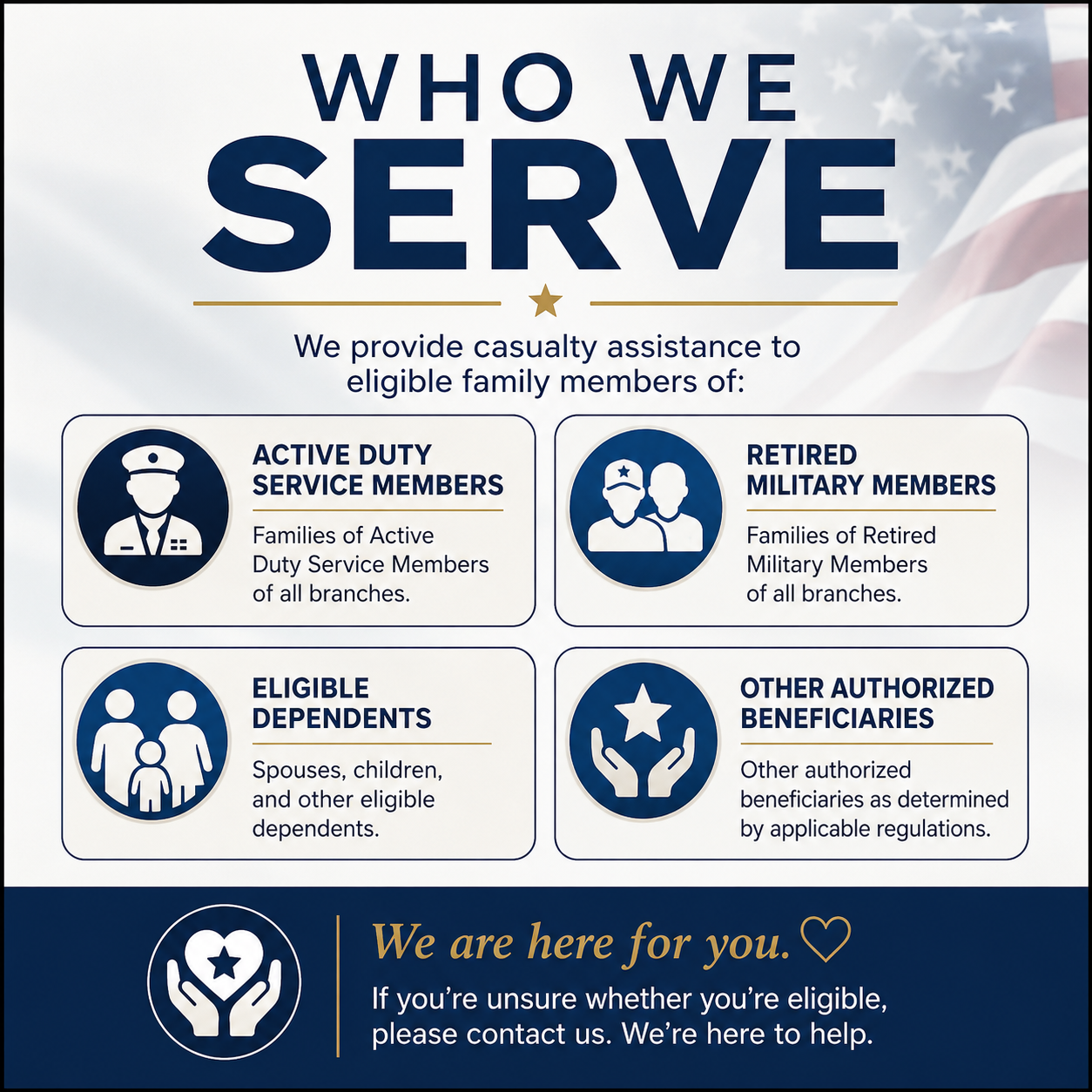
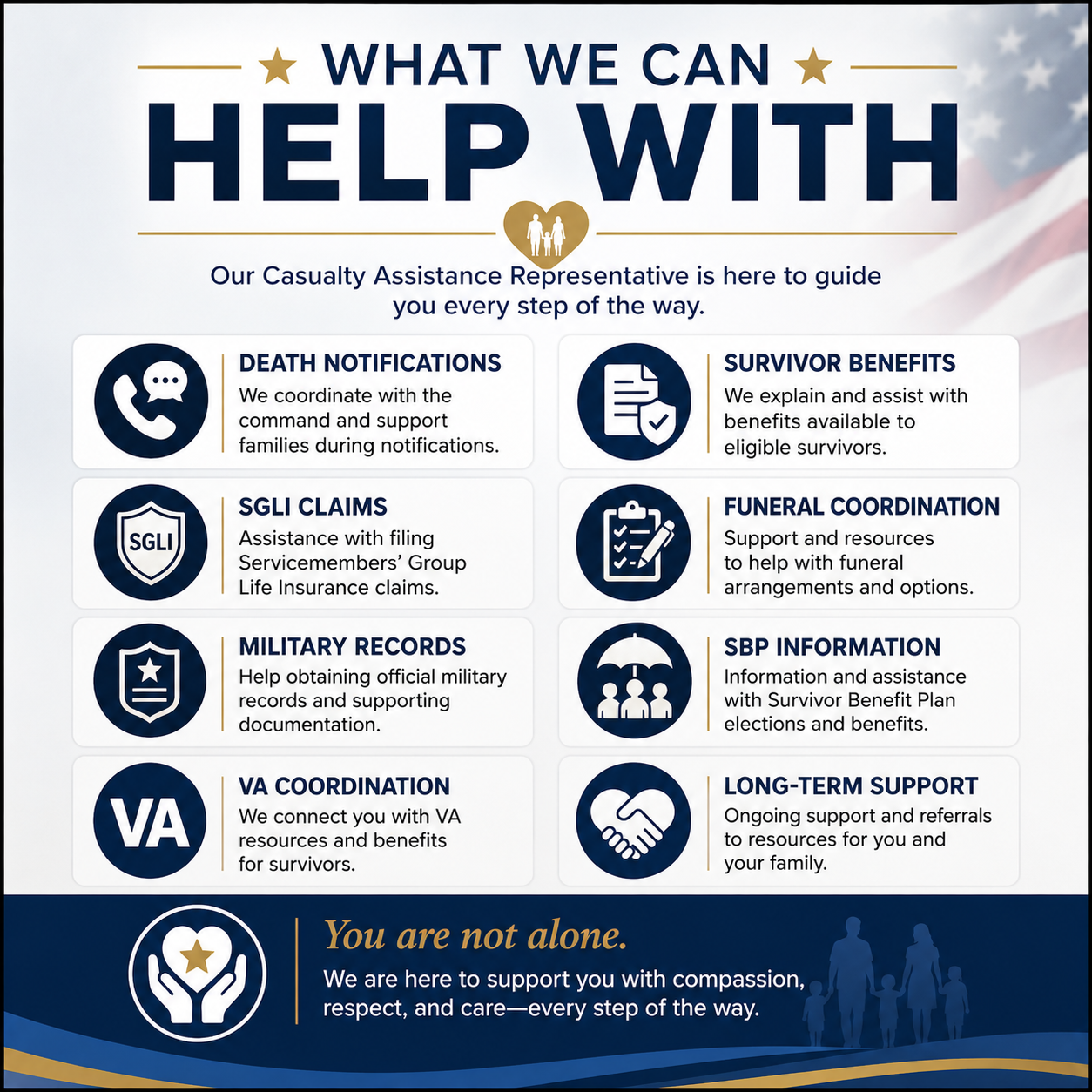
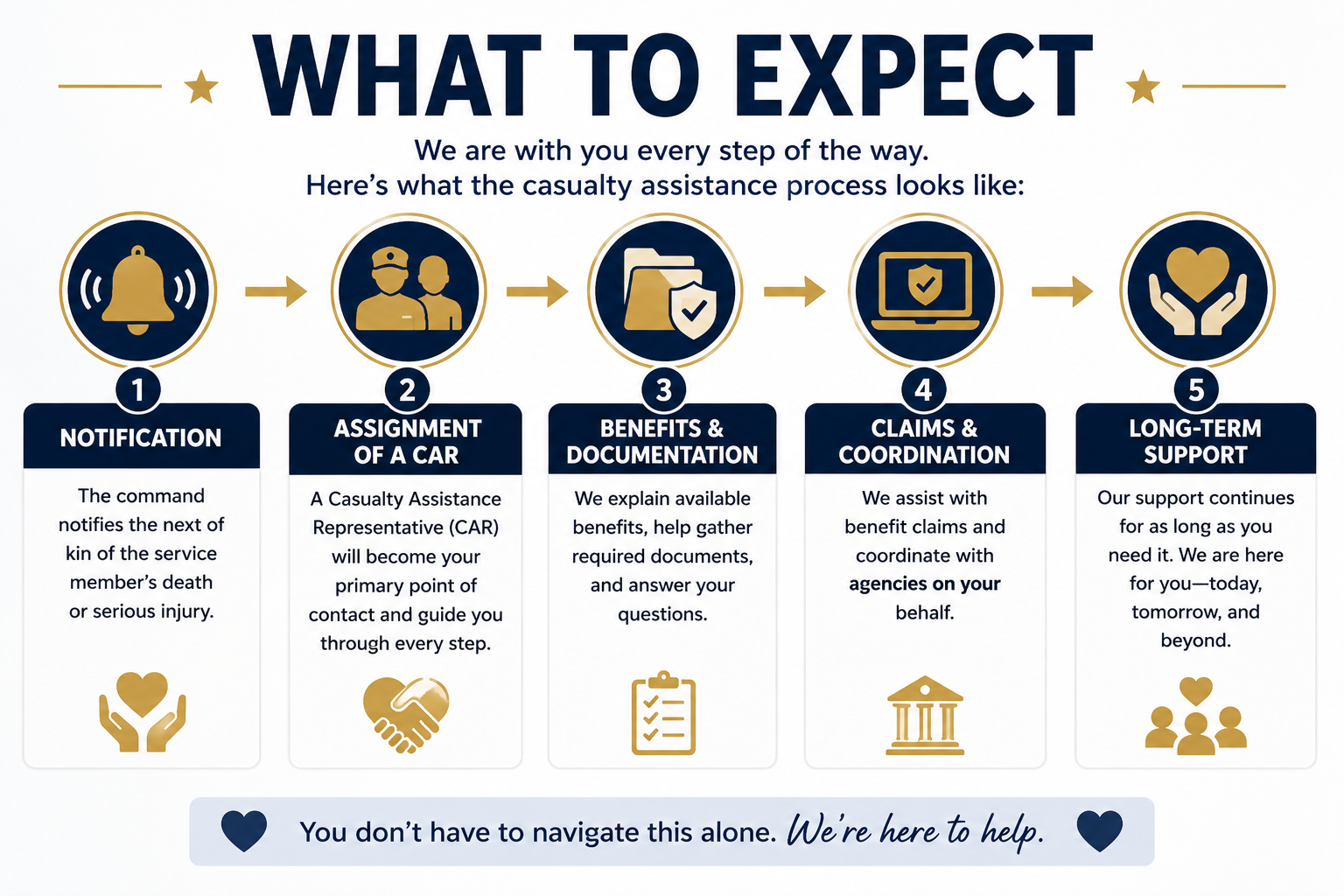
The loss or serious injury of a loved one can be overwhelming. Our Casualty Assistance Representative (CAR) is here to guide eligible family members through every step of the casualty assistance process—from understanding benefits to connecting you with long-term support.
Whether you have questions today or months from now, you don’t have to navigate this alone.
Understanding Your Survivor Benefits & Resources
Life Insurance Benefits
Survivor Benefits
Military Records
Financial Resources
Grief Support
Helpful Resources
Understanding Casualty Assitance
What is Casualty Assistance?
Casualty Assistance provides compassionate, personalized support to eligible family members following the death, serious illness, injury, or missing status of a Service Member. Your Casualty Assistance Representative (CAR) serves as your primary point of contact throughout the process.
How We Help
Your CAR can assist with:
- Understanding survivor benefits
- Coordinating required documentation
- Filing claims
- Connecting you with military and community resources
- Providing continued support throughout the process
Continued Support
Casualty Assistance doesn’t end after paperwork is complete. Our goal is to ensure survivors understand the benefits available to them and have ongoing access to the resources they need.
🛡️ Life Insurance Benefits
Servicemembers' Group Life Insurance (SGLI)
What is it?
Servicemembers’ Group Life Insurance (SGLI) is a low-cost life insurance program that provides financial protection to designated beneficiaries following the death of an eligible Service Member. Most active-duty Service Members and many members of the National Guard and Reserve are automatically covered.
Who may qualify?
SGLI benefits are paid to the beneficiary (or beneficiaries) designated by the Service Member. If no beneficiary is designated, payment is made according to the order of precedence established by federal law.
How do beneficiaries file a claim?
Beneficiaries should complete the appropriate SGLI death claim form and submit it to the Office of Servicemembers’ Group Life Insurance (OSGLI), typically with assistance from their Casualty Assistance Officer. Required documentation generally includes the completed claim form, a certified copy of the death certificate, and any additional documents requested to verify eligibility.
Need more information?
🔗 Visit the VA Servicemembers’ Group Life Insurance (SGLI) webpage.
Family Servicemembers' Group Life Insurance (FSGLI)
What is it?
Family Servicemembers’ Group Life Insurance (FSGLI) provides life insurance coverage for the spouses and dependent children of Service Members who are insured under Servicemembers’ Group Life Insurance (SGLI). Eligible spouses may receive up to $100,000 in coverage (not to exceed the Service Member’s SGLI coverage), while eligible dependent children are automatically covered for $10,000 at no cost.
Who may qualify?
Eligible spouses of Service Members covered by full-time SGLI may qualify for spouse coverage, and eligible dependent children are automatically insured. Coverage and eligibility are subject to VA and Department of Defense requirements.
How do benefits differ from SGLI?
Unlike SGLI, which insures the Service Member, FSGLI provides coverage for the Service Member’s eligible spouse and dependent children. If a covered spouse or dependent child passes away, the life insurance benefit is paid to the insured Service Member.
How do you file a claim?
The Service Member files an FSGLI claim through their branch of service or Casualty Assistance Office. Supporting documentation typically includes the appropriate claim form, a certified copy of the death certificate, and any additional documentation needed to verify eligibility.
Need more information?
🔗 Visit the VA Family Servicemembers’ Group Life Insurance (FSGLI) webpage.
Traumatic Servicemembers' Group Life Insurance (TSGLI)
What is it?
Traumatic Servicemembers’ Group Life Insurance (TSGLI) is an automatic benefit included with full-time Servicemembers’ Group Life Insurance (SGLI). It provides a one-time, tax-free payment of $25,000 to $100,000 to eligible Service Members who suffer a qualifying traumatic injury resulting in a covered loss.
Who may qualify?
Service Members who were covered by SGLI at the time of a qualifying traumatic injury may be eligible if the injury results in a covered loss, such as certain amputations, paralysis, severe burns, loss of sight, or other qualifying conditions established by the Department of Veterans Affairs.
When does it apply?
TSGLI is designed to help offset the financial impact of a severe traumatic injury by assisting with expenses related to recovery, rehabilitation, and adapting to life after the injury. Unlike SGLI, it is not a death benefit—it is paid directly to the injured Service Member.
How do you file a claim?
The injured Service Member submits Application for TSGLI Benefits (SGLV 8600) through their branch of service. The application must include medical documentation supporting the qualifying injury and covered loss.
Need more information?
🔗 Visit the VA Traumatic Servicemembers’ Group Life Insurance (TSGLI) webpage.
🇺🇸 Survivor Benefits
Survivor Benefit Plan
What is it?
The Survivor Benefit Plan (SBP) provides ongoing monthly income to eligible beneficiaries after the death of a retired Service Member.
Who may qualify?
Eligible spouses, former spouses, dependent children, or other designated beneficiaries.
Need more information?
🔗 Visit the official DFAS Survivor Benefit Plan webpage.
VA Survivor Benefits
What are they?
The Department of Veterans Affairs (VA) offers a variety of benefits to eligible surviving family members of Service Members and Veterans. These programs can provide financial assistance, education support, home loan benefits, and burial and memorial benefits.
Who may qualify?
Eligibility varies by program but may include surviving spouses, dependent children, and, in some cases, dependent parents. Qualification depends on factors such as the Service Member’s military service, character of discharge, and the circumstances of their death.
What benefits are available?
Eligible survivors may qualify for:
- Dependency and Indemnity Compensation (DIC) – A tax-free monthly benefit for eligible survivors.
- Education Benefits – Assistance through programs such as Survivors’ and Dependents’ Educational Assistance (DEA).
- VA Home Loan Benefits – Home loan guaranty benefits for eligible surviving spouses.
- Burial & Memorial Benefits – Burial in a VA national cemetery, a government-furnished headstone or marker, a burial flag, and, when eligible, burial allowances.
How do you apply?
Applications vary depending on the benefit being requested. Survivors can apply online, by mail, through an accredited Veterans Service Organization (VSO), or with assistance from a VA representative or Casualty Assistance Officer.
Need more information?
🔗 Visit the VA Survivor Benefits webpage.
Other Survivor Benefits
What are they?
In addition to military and VA benefits, surviving family members may qualify for other federal and military programs that provide healthcare, financial assistance, installation access, and shopping privileges.
Who may qualify?
Eligibility varies by program but may include surviving spouses, dependent children, and other eligible family members based on military status, dependency, and benefit requirements.
What benefits are available?
Eligible survivors may qualify for:
- Social Security Survivor Benefits – Monthly benefits for eligible spouses, children, or dependent parents through the Social Security Administration.
- TRICARE – Continued health care coverage for eligible surviving family members.
- Commissary & Exchange Privileges – Continued access to military commissaries and exchanges for eligible survivors.
- Updated Military ID Card & DEERS Enrollment – Survivors should update their ID card and DEERS records to maintain eligibility for healthcare, installation access, and other military benefits.
What should you do first?
Contact your Casualty Assistance Officer or the appropriate agency as soon as possible after the loss to update records, determine eligibility, and avoid interruptions in benefits.
Need more information?
🔗 Visit the Military OneSource Survivor Resources webpage.
📄 Military Records & Documentation
Important Documents
- DD Form 1300
- DD Form 214
- Death Certificate
- Marriage Certificate
- Birth Certificates
- Social Security Cards
- Banking Information
Military Records
What are they?
Military records document a Service Member’s military career and are often required to apply for survivor benefits, VA benefits, life insurance claims, burial honors, and other military or government programs. Common records include the DD Form 214, service personnel records, and military medical records.
Who may request them?
Eligible requestors include the Veteran, the un-remarried surviving spouse, next of kin (such as a parent, child, or sibling), or an authorized representative. Proof of death and proof of relationship may be required when requesting records for a deceased Service Member or Veteran.
How do you request them?
Military records can be requested online through the National Archives, or by submitting Standard Form 180 (SF-180) to the National Personnel Records Center (NPRC). The SF-180 may be mailed or faxed and is the recommended method for requesting military personnel and medical records.
Need more information?
🔗 Request Military Service Records (National Archives)
Required Notifications
What are they?
Following the death of a Service Member or military retiree, several military and federal agencies must be notified to ensure survivor benefits are established, records are updated, and payments are processed correctly. For active-duty deaths, many of these notifications are coordinated by the assigned Casualty Assistance Officer (CAO).
Who should be notified?
Depending on your situation, notifications may include:
- Defense Finance and Accounting Service (DFAS) – Retired pay, Survivor Benefit Plan (SBP), and military pay matters.
- Department of Veterans Affairs (VA) – Dependency and Indemnity Compensation (DIC), burial benefits, life insurance, and other VA survivor benefits.
- DEERS (Defense Enrollment Eligibility Reporting System) – Updates dependent records and eligibility for military benefits.
- TRICARE – Updates healthcare eligibility and enrollment for surviving family members.
- Social Security Administration (SSA) – Reports the death and determines eligibility for Social Security survivor benefits.
- Office of Servicemembers’ Group Life Insurance (OSGLI) – Processes SGLI and FSGLI life insurance claims, when applicable.
Why is this important?
Prompt notification helps prevent delays in survivor benefits, avoids overpayments that may require repayment, and ensures eligible family members continue receiving healthcare, financial assistance, and other military benefits without interruption.
Need more information?
🔗 DFAS
🔗 Department of Veterans Affairs
🔗 TRICARE
💰 Financial Resources
Emergency Financial Assistance
What are they?
Military financial assistance organizations provide emergency financial support to eligible Service Members, retirees, and surviving family members during times of unexpected hardship. Assistance may be available for essential expenses such as funeral costs, emergency travel, housing, utilities, food, and other immediate financial needs.
Who may qualify?
Eligibility varies by organization and military affiliation. Surviving spouses and eligible family members may qualify for assistance based on their relationship to the deceased Service Member and the organization’s policies.
What resources are available?
- Air Force Aid Society (AFAS) – Emergency financial assistance and community support for Air Force and Space Force families.
- Navy-Marine Corps Relief Society (NMCRS) – Interest-free loans, grants, and financial assistance for Navy and Marine Corps families.
- Army Emergency Relief (AER) – Financial assistance for eligible Army Soldiers, retirees, survivors, and their families.
- Coast Guard Mutual Assistance (CGMA) – Emergency financial assistance and family support for Coast Guard members and eligible survivors.
How do you get assistance?
Contact your local Military & Family Readiness Center, Casualty Assistance Officer, or the appropriate military relief organization to determine eligibility and begin the application process.
Need more information?
🔗 Air Force Aid Society (AFAS)
Financial Counseling
What is it?
The Military & Family Readiness Center (M&FRC) offers free, confidential financial counseling to help surviving family members navigate the financial changes that often follow the loss of a loved one. Financial counselors provide personalized guidance to help survivors make informed financial decisions and build long-term financial stability.
Who may qualify?
Financial counseling is available to eligible surviving spouses, family members, and other authorized military beneficiaries. Eligibility may vary depending on military affiliation and local installation services.
What can a financial counselor help with?
Financial counselors can assist with:
- Creating and managing a household budget.
- Understanding survivor benefits and financial entitlements.
- Planning for financial transitions after the loss of a loved one.
- Reviewing insurance proceeds and changes in income.
- Managing debt and developing long-term financial goals.
- Connecting families with additional military and community financial resources.
How do you get started?
Contact your local Military & Family Readiness Center to schedule a confidential appointment with a Personal Financial Counselor or Accredited Financial Counselor.
Need more information?
DFAS
What is it?
The Defense Finance and Accounting Service (DFAS) manages military retired pay, the Survivor Benefit Plan (SBP), and other military pay-related benefits. After the death of a military retiree, DFAS works with eligible survivors to stop retired pay, process final payments, and establish any survivor annuity benefits.
Who should contact DFAS?
Surviving spouses, designated beneficiaries, executors, or other authorized representatives should contact DFAS as soon as possible following the death of a military retiree. Prompt notification helps prevent overpayments and allows DFAS to begin processing any eligible survivor benefits.
What can DFAS help with?
DFAS can assist with:
- Reporting the death of a military retiree.
- Stopping retired pay to prevent overpayments.
- Processing Survivor Benefit Plan (SBP) annuity payments.
- Paying any eligible Arrears of Pay (AOP).
- Answering questions about military retired pay and survivor entitlements.
How do you get started?
Deaths can be reported online through the askDFAS Notification of Death tool, by phone, or by mail. Survivors should have the retiree’s identifying information available and be prepared to provide a copy of the death certificate if requested.
Need more information?
🔗 Report a Retiree’s Death (DFAS)
❤️ Grief & Family Support
Grief Counseling
What is it?
Grief counseling provides compassionate emotional support to help surviving family members cope with the loss of a loved one. A variety of military and community resources are available to assist survivors as they navigate the grieving process and adjust to life after loss.
Who may qualify?
Eligible surviving spouses, children, and other military family members may have access to grief counseling and emotional support services through military programs, chaplains, and community organizations. Eligibility may vary depending on the resource.
What resources are available?
- Military & Family Life Counselors (MFLCs) – Free, confidential, non-medical counseling for eligible military families.
- Military Chaplains – Spiritual care, grief counseling, crisis support, and referrals regardless of religious affiliation.
- Community Counseling Services – Licensed mental health professionals, grief support groups, and nonprofit organizations that specialize in bereavement care.
How do you get started?
Speak with your Casualty Assistance Officer, Military & Family Readiness Center, or healthcare provider to identify the counseling resources that best meet your family’s needs.
Need more information?
🔗 Military OneSource – Non-Medical Counseling
🔗 Military OneSource – Casualty Assistance & Survivor Support
Tragedy Assistance Program for Survivors (TAPS)
What is it?
The Tragedy Assistance Program for Survivors (TAPS) is a national nonprofit organization that provides compassionate care and comprehensive support to anyone grieving the death of a military service member or Veteran, regardless of the cause of death or the survivor’s relationship to the deceased.
Who may qualify?
TAPS services are available at no cost to surviving spouses, children, parents, siblings, battle buddies, battle buddies, battle buddies’ families, caregivers, and others who have experienced the loss of a military-connected loved one.
What services are available?
TAPS offers a wide range of support services, including:
- 24/7 compassionate care and casework assistance.
- Peer-based emotional support from trained survivor volunteers.
- Grief counseling referrals and bereavement resources.
- Survivor seminars, retreats, and camps for adults and children.
- Connections to military, VA, and community resources.
How do you get started?
Survivors can contact TAPS anytime by phone or online to speak with a compassionate care professional who can help identify available resources and provide ongoing support.
Need more information?
🔗 Tragedy Assistance Program for Survivors (TAPS)
Military OneSource
What is it?
Military OneSource is a free Department of Defense program that provides confidential support, information, and referrals to service members, military families, and eligible survivors. The program is available 24 hours a day, 7 days a week, and connects survivors with trusted resources during times of transition and loss.
Who may qualify?
Eligible surviving spouses, dependent children, and other authorized military family members may access Military OneSource services. Eligibility varies based on military affiliation and survivor status.
What services are available?
Military OneSource can help with:
- Free, confidential, non-medical counseling.
- Resource navigation and referrals to military and community services.
- Financial, legal, and tax consultations.
- Specialty consultations for education, relocation, and caregiving.
- Ongoing support and information throughout the survivor journey.
How do you get started?
Contact Military OneSource by phone or visit their website to speak with a consultant who can help connect you with the resources and support that best meet your family’s needs.
Need more information?
🔗 Military OneSource – Casualty Assistance & Survivor Support
📞 Military OneSource: 800-342-9647 (available 24/7)
Community Resources
A list of local grief support organizations, mental health services, support groups, and counseling options available to families in the Charleston and Lowcountry area.
Support for Children & Teens
- Sesame Street for Military Families – Grief – Interactive, age-appropriate videos and activities to help young children understand and cope with the loss of a loved one.
- Sesame Street – Something Small – A gentle, age-appropriate video from Sesame Street that helps young children understand and talk about the emotions that come with the loss of a loved one.
- Sesame Street – Strategies for Parents After a Loved One’s Death by Suicide – A resource offering supportive language and coping strategies to help caregivers guide young children through grief following a loved one’s suicide.
- Children of Fallen Patriots Foundation – Provides college scholarships and educational counseling to military children who have lost a parent in the line of duty.
- The Dougy Center – Grief Support for Children & Families – National center for grieving children and families offering resources, podcasts, toolkits, and in-person/virtual programs.
Helpful Resources
Downloadable Guides
- Estate Planning Checklist: A helpful guide to organizing legal, financial, and personal documents to ensure your affairs are in order before or after a loved one’s passing. Estate Planning Checklist
- DoD Casualty Assistance Handbook (PDF): Comprehensive guide for all branches; excellent resource for families. Download it here
- The Days Ahead (TAPS Guide – English & Spanish): A practical and compassionate guide from TAPS for navigating the early days of grief after the death of a military loved one, available in both English and Spanish. English PDF | Spanish PDF
Federal & Military Resources
- Burial Flags: Eligible family members may request a U.S. flag to honor a deceased veteran’s military service during burial ceremonies.
- Department of Veterans Affairs (VA): Survivor benefits, burial benefits, education benefits, and claims.
- Defense Finance and Accounting Service (DFAS): Survivor Benefit Plan (SBP), retired pay, and military pay questions.
- Military OneSource: Confidential counseling, financial guidance, and resource navigation.
- Tragedy Assistance Program for Survivors (TAPS): Peer-based emotional support, survivor seminars, grief resources, and long-term support.
Bereavement & Mental Health Support
- National Military Family Association (NMFA) – Offers a grief and loss section with information, stories, and connection to survivor communities.
- Give an Hour – Provides free mental health support—including grief counseling—for military families and veterans.
- VA Bereavement Counseling (for surviving immediate family of service members who died in the line of duty) – Grief counseling through the VA’s Readjustment Counseling Services and Vet Centers.
- Sesame Street – Taking Care of Ourselves While Grieving – Tips and self-care tools for adults coping with grief, emphasizing that caring for oneself is an important part of healing while supporting others.
Retiree Support
COMING SOON!!
Branch-Specific Resources
Navy Casualty Assistance Calls Officer (CACO)
The Navy assigns a Casualty Assistance Calls Officer (CACO) to personally assist the next of kin following the death or serious injury of a Sailor. Your CACO serves as your primary guide throughout the casualty assistance process, helping with notifications, benefits, required documentation, and coordination with military agencies.
What Your CACO Can Help With
- Death gratuity and life insurance claims
- Survivor Benefit Plan (SBP) guidance
- Funeral honors and burial assistance
- Military records and required documentation
- Coordination with the Department of Veterans Affairs (VA)
- Referrals to long-term survivor support programs
Navy Gold Star Program
The Navy Gold Star Program provides long-term support to surviving family members through information, referral services, education, and community events. Services remain available long after the initial casualty assistance process has ended.
Navy-Marine Corps Relief Society
Eligible surviving family members may qualify for financial assistance, educational programs, and other support services through the Navy-Marine Corps Relief Society.
Navy Funeral Honors Program
The Navy Funeral Honors Program ensures eligible deceased Sailors and Veterans receive military funeral honors in recognition of their honorable service. Funeral honors typically include the ceremonial folding and presentation of the United States flag, the playing of Taps, and the presence of a Navy honors detail. Additional honors may be provided based on eligibility and available resources.
Navy Burial at Sea
The Navy Burial at Sea Program provides eligible active duty members, retirees, Veterans, and certain family members the opportunity to have their cremated remains or casketed remains respectfully committed to the sea. This time-honored naval tradition is conducted aboard U.S. Navy vessels while deployed and offers families a meaningful way to honor their loved one’s military service.
Serving Navy Families at Joint Base Charleston: Our Military & Family Readiness Center works alongside your assigned Navy Casualty Assistance Calls Officer (CACO). If you’re unsure where to start or need additional support, we’re here to help connect you with the appropriate Navy and Department of Defense resources.
Coast Guard Casualty Assistance
The Coast Guard assigns a Casualty Assistance Calls Officer (CACO) to support the primary next of kin following the death, serious injury, or missing status of a Coast Guard member. Your CACO serves as your primary point of contact, helping you understand available benefits, complete required paperwork, and navigate the casualty assistance process.
What Your CACO Can Help With
- Death gratuity and life insurance claims
- Survivor Benefit Plan (SBP) guidance
- Funeral honors and burial assistance
- Military records and required documentation
- Coordination with the Department of Veterans Affairs (VA)
- Referrals to long-term survivor support resources
Coast Guard Mutual Assistance (CGMA)
The Coast Guard Mutual Assistance provides financial assistance, education programs, and support services to eligible Coast Guard members, retirees, and surviving family members. Programs may include emergency financial assistance, education grants, and survivor support.
Supporting Coast Guard Families: The Joint Base Charleston Military & Family Readiness Center works alongside your assigned Coast Guard Casualty Assistance Calls Officer (CACO). If you need guidance or additional support, we’re here to help connect you with Coast Guard, Department of Defense, and community resources throughout the casualty assistance process.
Army Casualty Assistance
The Army assigns a Casualty Assistance Officer (CAO) to assist the primary next of kin following the death, serious injury, or missing status of a Soldier. Your CAO serves as your primary point of contact, providing compassionate guidance through benefits, required documentation, military procedures, and available support services.
What Your CAO Can Help With
- Death gratuity and life insurance claims
- Survivor Benefit Plan (SBP) guidance
- Funeral honors and burial assistance
- Military records and required documentation
- Coordination with the Department of Veterans Affairs (VA)
- Referrals to survivor support programs and military resources
Army Emergency Relief (AER)
Army Emergency Relief provides emergency financial assistance, scholarships, and survivor support to eligible Soldiers, retirees, and their families. Financial assistance may be available to help families navigate unexpected hardships following the loss of a Soldier.
Survivor Outreach Services (SOS)
Survivor Outreach Services is the Army’s official long-term support program for surviving families. SOS provides ongoing assistance, resource referrals, benefits coordination, and community support for as long as families need services.
Supporting Army Families: The Joint Base Charleston Military & Family Readiness Center works alongside your assigned Army Casualty Assistance Officer (CAO). If you have questions or need additional support, we’re here to connect you with Army, Department of Defense, and community resources throughout the casualty assistance process.
Air Force Families Forever (AFFF)
Air Force Families Forever (AFFF) is the Air Force’s official long-term survivor support program for the families of deceased Airmen and Guardians.
The program connects surviving family members with dedicated Survivor Care Representatives who provide:
- Personalized support and advocacy
- Benefits and resource guidance
- Long-term case management
- Community connections and survivor events
- Referrals to military and civilian support services
Support is available for as long as surviving family members choose to participate.